
Kane County Criminal Court Cases
Kane County forms Illinois's 16th Judicial Circuit. Its unified Circuit Court hears felony and state-law misdemeanor cases. Traffic, ordinance, and assigned misdemeanor calendars also run at branch venues in St. Charles, Aurora, and Elgin. Those branches are parts of the circuit, not stand-alone municipal criminal courts. The Circuit Clerk is the custodian of filed complaints, informations, indictments, docket entries, orders, schedules, and dispositions.
The main criminal court ecosystem is at the Kane County Judicial Center, 37W777 Illinois Route 38, St. Charles. Court Services, the State's Attorney, and Public Defender also work there. The jail is next door at 37W755 Route 38, but jail staff answer custody questions, not what a judge ordered. This short address gap is easy to miss and can send a records request to the wrong counter.
The Illinois Courts directory shows Kane County's court venues and official court details.
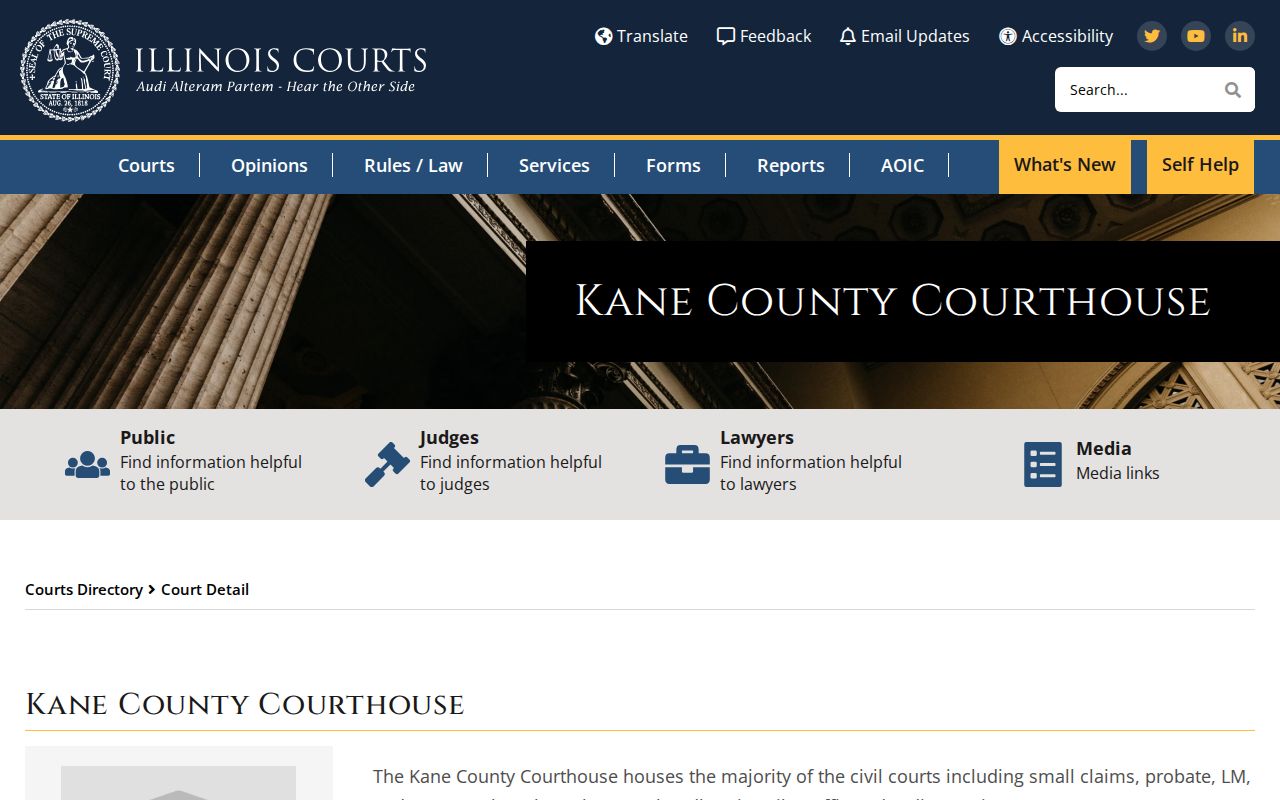
The directory helps confirm the proper Kane County venue before a trip or records call.
Kane County Clerk Case Portal
The Kane County Circuit Clerk places eServices and court-record access at the center of its public site. Searchers should use an exact case number when it is known. For a name search, the clerk's practical syntax is surname first, followed by a comma and given name. A common name needs a filing year, case type, or other public context to avoid a false match.
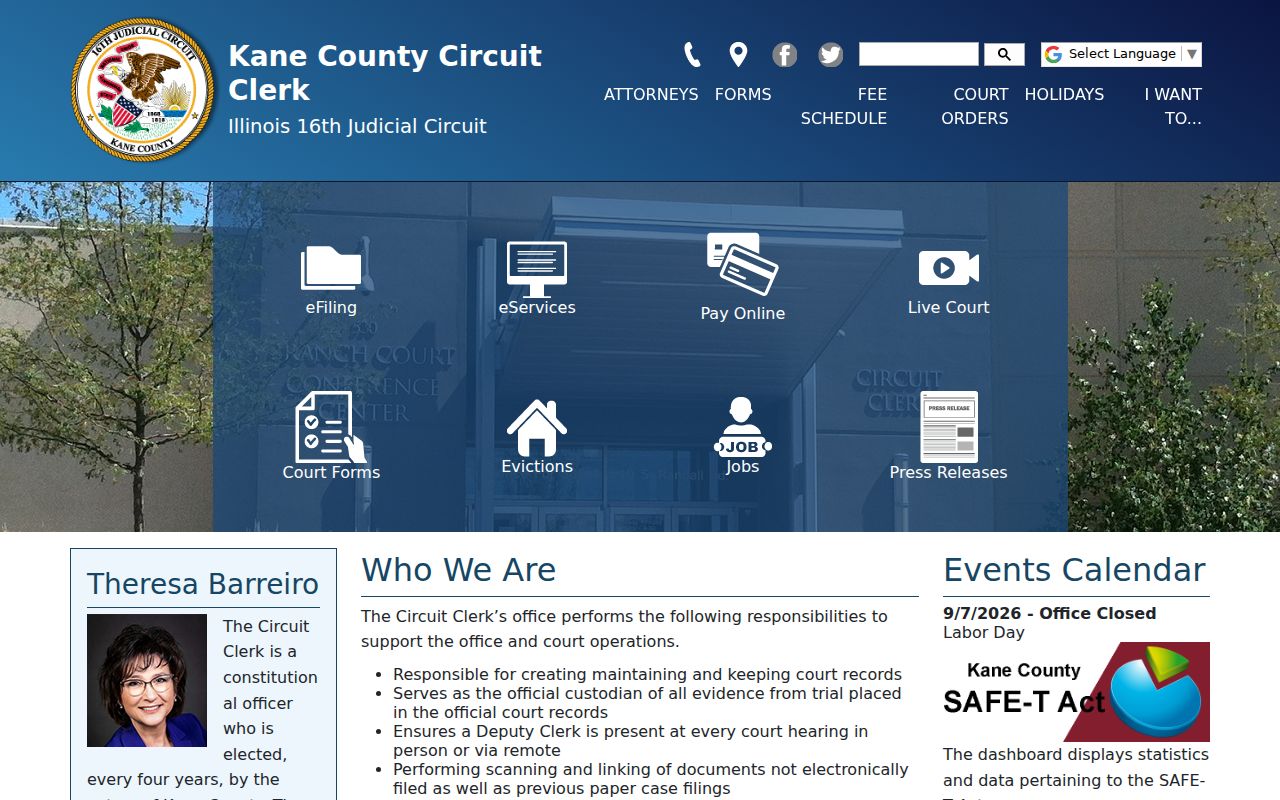
The clerk page is the official doorway to the Kane County docket and copy services.
Searching Kane County Case Records
The online public index is free, though documents and certified copies can carry fees. Search results are an index to court activity. They are not a complete statewide history, and a top-level status does not replace the result for each charge.
- Open the Circuit Clerk's eServices area and choose Search Court Records.
- Enter the exact case number without punctuation when available, or search the party name as LAST, FIRST.
- Narrow a broad result by criminal or traffic case type, filing year, and any public identifier shown.
- Open the docket and read each count, event, hearing, order, and final disposition.
- Contact the clerk for a file that is archived, an image that is unavailable, or a certified copy.
The official online court-record instructions route users to the live search.
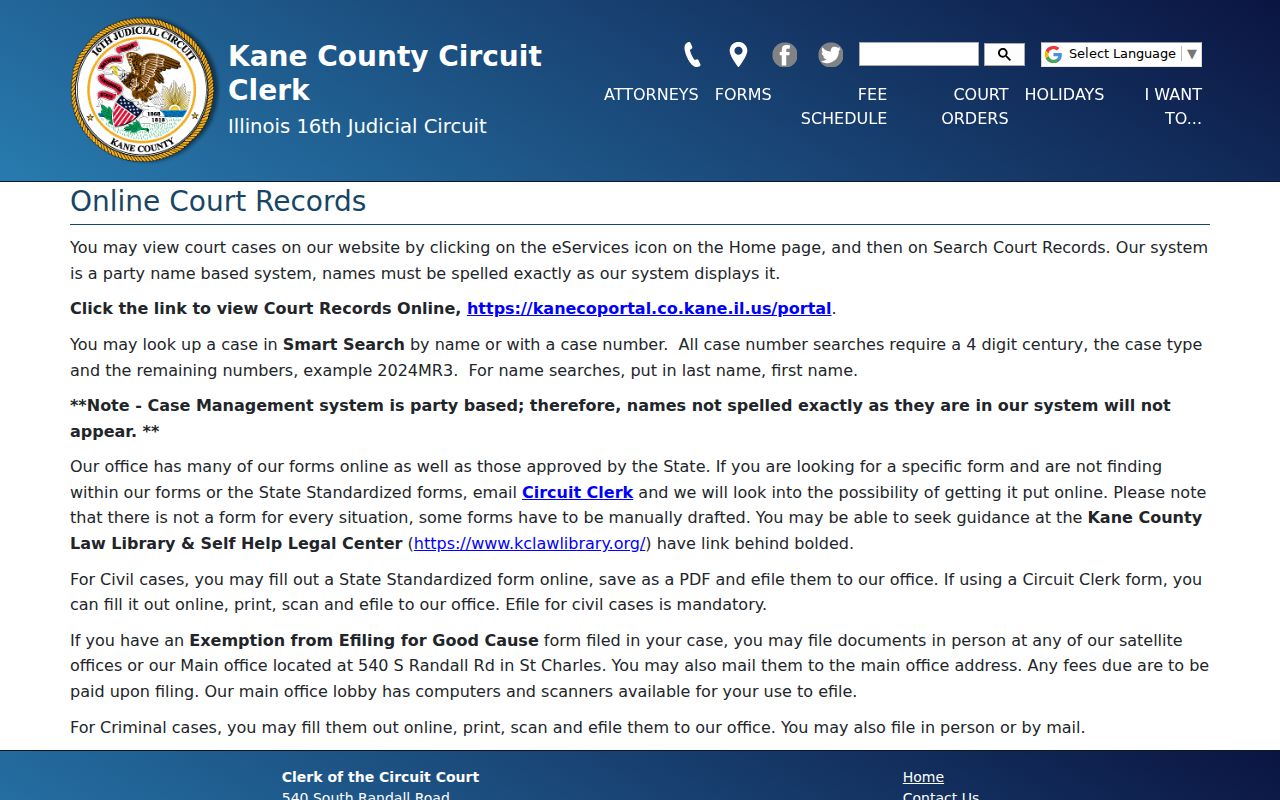
The instructions matter because the live vendor interface can change while the clerk remains the source of the record.
| Field | Type | Required | Use |
|---|---|---|---|
| Case Number | Text | No | Most precise route; use the local format shown on notices |
| Last or Business Name | Text | Conditional | Starts a party-name search |
| First Name | Text | No | Narrows a surname |
| Date of Birth | Date | No | May be limited or redacted |
| Case Type or Division | Select | No | Narrows to criminal or traffic records |
| Filing Year or Range | Date/select | No | Separates similar names and older cases |
Kane County Court Copy Costs
Online viewing and a formal copy are different services. The clerk fee schedule effective December 31, 2025 lists ordinary copies at $2 for the first page, $0.50 for pages two through twenty, and $0.25 for each later page. A summary printout is $6 per page. A manual record search is $6 per year and name. Nonjudgment certification is $6, other judgment certification is $10, and clerk mailing is $10 plus postage.
Ask the clerk to quote the current charge before ordering a large Kane County file. State law and county schedules can change. Clerk staff can locate and certify records, but they cannot say what a docket entry means for a person's legal rights.
Note: A free docket view may identify a filing even when the document image itself requires a copy request or payment.
Inside a Kane County Case File
A Kane County case file explains what prosecutors filed and what the court did. Read at count level. A case may contain a conviction on one count and a dismissal on another, so the word “disposed” only means court processing ended.
| Header | Case number, filing date, case type, division, and status |
|---|---|
| Parties | State of Illinois, defendant, and public attorney entries |
| Charges | Count, description, statute, class, and filed or amended status |
| Docket | Appearances, pleas, motions, notices, hearings, orders, trial, and judgment |
| Schedule | Date, time, venue, hearing type, and judicial officer when shown |
| Disposition | Count-level conviction, dismissal, acquittal, or other result and date |
| Sentence | Custody, probation, supervision, fines, restitution, and public balances |
| Documents | Docket description; image access varies by filing and user access |
Private identifiers, victim or minor data, and protected filings may be redacted. Booking charges can also differ from filed counts after prosecutor review. For the arrest-to-court distinction, the county's Arrest Lookup explains the separate booking trail.
Reading Kane County Dispositions
Illinois docket terms describe steps and results. They should not be guessed from the case status alone. A final order and the disposition beside each count provide the clearest public answer.
- Disposition
- The result of a charge, such as conviction, dismissal, or acquittal.
- Nolle prosequi
- A prosecutor's formal choice not to continue a charge at that time.
- Supervision
- An Illinois outcome that may avoid a judgment of conviction when completed, depending on the offense and law.
- Information
- A charging document filed by the prosecutor where Illinois law permits.
- Indictment
- A charging document returned by a grand jury.
Older Kane County files may use legacy bond terms. Illinois's current pretrial system no longer uses cash bail in the former way, so read the dated order in its own legal setting.
How a Kane County Case Moves
A criminal file develops over time. An arrest or citation may come first, but the State's Attorney decides what charges to file. The court then records the plea, motions, hearings, judgment, and sentence. A same-day event can take time to reach every connected system.
Case flow: Charges Filed › Arraignment › Pretrial › Plea or Trial › Disposition › Sentencing
Discovery and pretrial motions sit between arraignment and a plea or trial. After judgment, the file may gain post-judgment motions, an appeal notice, probation events, or warrant entries. The docket is therefore a timeline, not one fixed report.
Kane County Problem-Solving Courts
Kane County reports four certified problem-solving courts: Drug Rehabilitation Court, Veterans Court, Treatment Alternative Court, and DUI Court. These voluntary, structured programs can involve the judiciary, State's Attorney, Public Defender, probation, Diagnostic Center, jail, Veterans Assistance Commission, treatment providers, and other partners.
Participation does not itself hide the Kane County criminal court case. The public docket may still show filed charges, program-related events, and the final order. Whether a later record can be sealed depends on the charge, disposition, waiting rules, and Illinois law, not merely the program name.
The Illinois Courts record-clearing forms provide the required statewide packet.
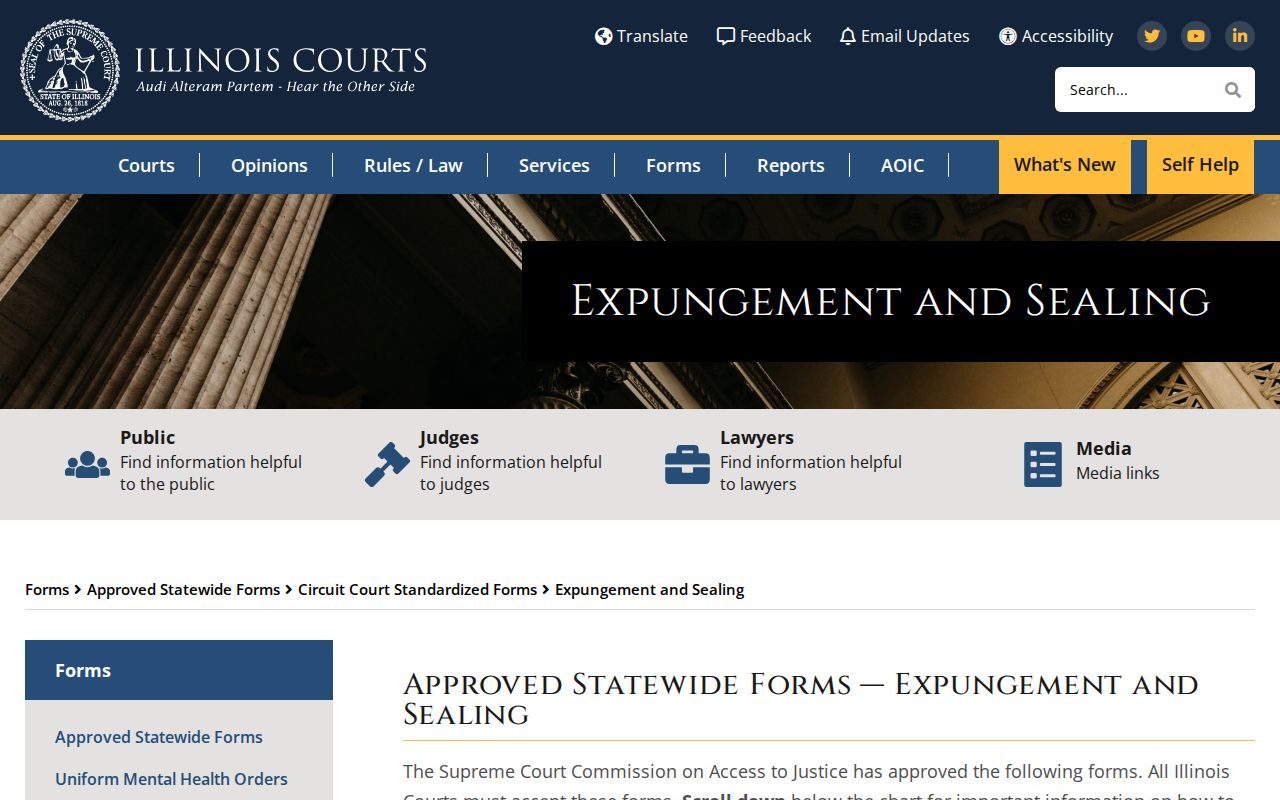
The forms show why complete case numbers, charges, agencies, and dispositions are vital before filing.
re:SearchIL Beyond Kane County
Kane's clerk search is the first source for a Kane Circuit Court case. re:SearchIL and eFileIL add a statewide remote-access and filing layer, but registration, user access level, and document availability affect what appears. They do not create one free, complete Illinois criminal-history search.
The statewide service can aid document access while the Kane County Circuit Clerk remains custodian of the local court file.
Federal criminal matters use PACER and the U.S. District Court for the Northern District of Illinois, not the Kane clerk. Historic researchers have another path: the Illinois State Archives index covers Kane Circuit Court files from 1836 through 1870, with PEOPLE entered as plaintiff to locate criminal cases.
Case Record Access and Restrictions
Illinois court files are broadly open, but not every record or field is public. Sealed and expunged matters, juvenile files, protected victim and minor data, private identifiers, and impounded filings may be missing or masked. Online access can also be narrower than the courthouse file. An absent name result is not proof that no proceeding occurred.
When a Kane County case is missing, check spelling and case format, then ask the Circuit Clerk about archives, venue, and public copy access. A city police report remains with the agency that made it, while court pleadings stay with the clerk. Under the Illinois Freedom of Information Act, police agencies assess their own records and exemptions; FOIA is not the route for asking the clerk to interpret a judicial decision.
Access point: A name match is not identity proof. Compare the public case context, and verify the result with the originating Kane County office.